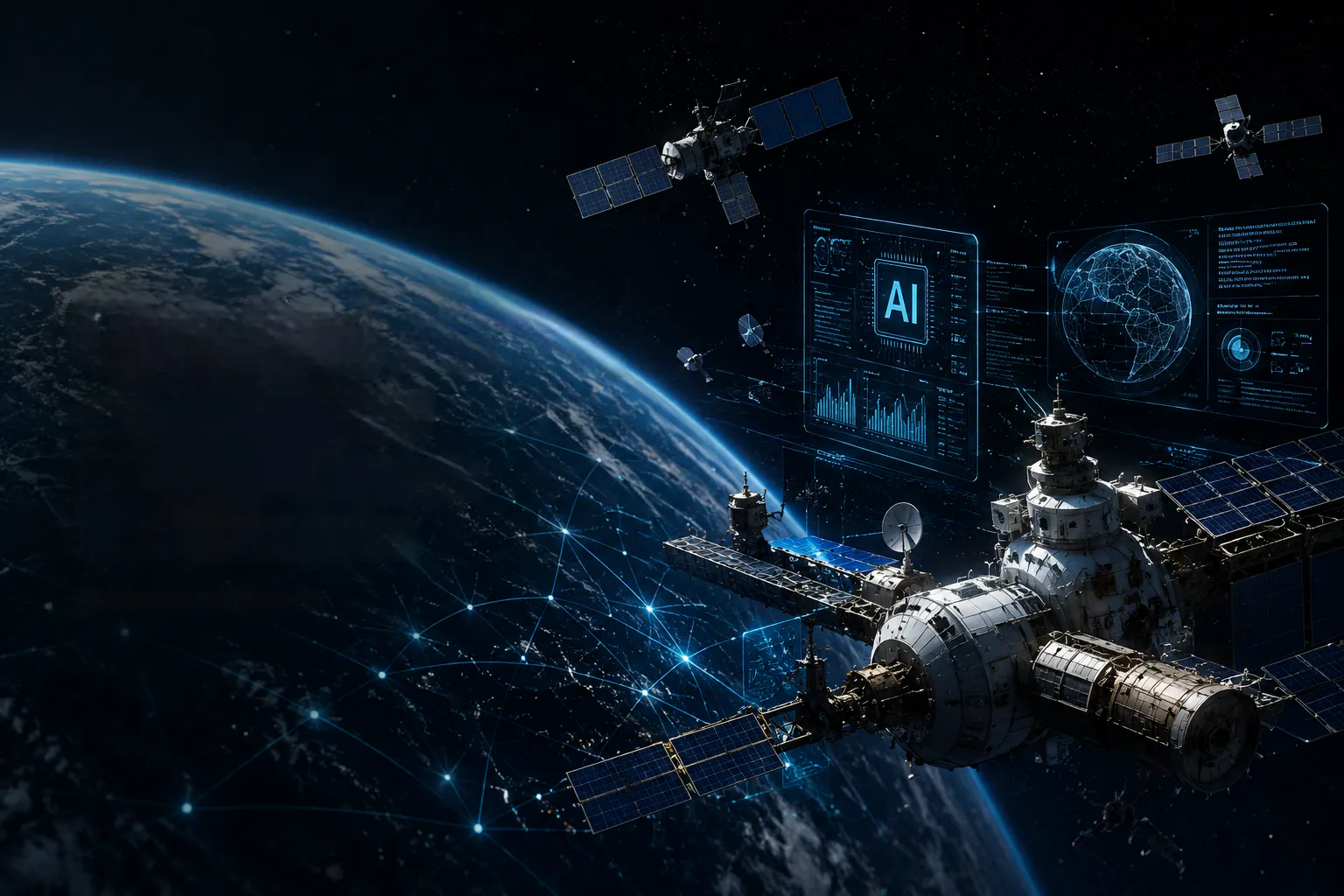
The modern satellite is evolving into something far more sophisticated than a machine floating silently above Earth. Over time, spacecraft have become a more intelligent system, capable of analysing information and making operational decisions independently. This transition marks the emergence of what can best be defined as orbital artificial intelligence, that is, the integration of advanced onboard computing and machine learning directly into space infrastructure.Unlike their predecessors, which depended heavily on instructions from Earth, the next generation or orbital systems will think, coordinate and respond autonomously and in real-time. In this way, orbital AI will fundamentally reshape how we view near-space and deep-space exploration over the coming decades.
From passive satellites to intelligent systems
While satellites performed the passive but heavy work such of relaying communications and collecting imagery, human operators on the ground remained responsible for interpreting information and managing spacecraft operations. That model is under strain under the weight of orbital expansion. Tens of thousands of satellites are expected to occupy low Earth orbit by the end of the decade, driven largely in part by commercial mega-constellations supporting broadband connectivity. remote -sensing and defence applications. The speed required for operational decision-making increases the need for orbital AI, as satellites can no longer rely solely on ground control for each and every manoeuvre or adjustment. Communication delays and especially growing congestion require onboard autonomy, as more stakeholders launch more space assets in a very limited space. Artificial intelligence offers a solution to this problem.
By integrating AI-enabled processors directly into spacecraft, satellites can coordinate operations without waiting for instructions from Earth. In practical terms, this transforms satellites from remote-controlled systems into semi-autonomous infrastructure.
Why orbital AI matters
AI’s strategic edge lies primarily in its speed and scale. Modern Earth observation satellites generate enormous quantities of data daily, far exceeding what can easily be transmitted back to Earth in raw form. AI systems operating onboard can process imagery before transmission, identifying useful information immediately while discarding redundant data. This reduces communications burdens while accelerating response times for various space applications, some of which include disaster monitoring, agriculture, maritime tracking and military reconnaissance. With regards to defence and security, a satellite capable of autonomously identifying missile launches gains operational advantages measured in minutes and even seconds. In these highly contested environments, those margins certainly matter.
Orbital AI is also becoming critical in the domain of Space Traffic Management (STM). Satellites operating in overcrowded highways need the ability to assess nearby traffic and adjust trajectories autonomously. The alternative would involve constant human supervision at a scale that may soon become unmanageable.
The military dimension
As with many space technologies, the military industrial complex, i.e. the boundary between civilian and military applications remains blurred. Artificial intelligence is forming part of the broader defence-oriented satellite networks to improve resilience.Autonomous systems are particularly attractive for military planners because they reduce reliance on vulnerable communications links, while bolstering responsiveness in dynamic environments. This has intensified broader geopolitical competitions surrounding AI infrastructure and broader geopolitical competition surrounding technologies. Nations gain disproportionate influence over future orbital operations as a result of their current technological “hegemony” here on Earth.
The United States and China are emerging as the dominant actors in the AI chips domain. American firms continue to lead globally in AI chip design, while China has also accelerated their efforts especially in building independent semiconductor components, with the purpose of boosting their industrial strength, linking directly to its aerospace ambitions.

AI beyond Earth orbit
As already mentioned, autonomy is vital when missions move further away from low-Earth orbit, into the realm of cislunar and deep-space. As outer space remains tenuous, spacecraft will therefore require systems capable of independent decision-making. NASA’s Artemis programme, the Lunar Gateway station and China’s expanding cislunar ambitions all point toward a future where autonomous infrastructure is indispensable for sustaining long-duration missions.Machines, much like they do on Earth, may be placed in scenarios requiring immediate response, and there may not always be a human to oversee these decisions. AI therefore becomes something of a fail-safe to ensure operations continue safely and efficiently.
Governance and ethical challenges
The rise of orbital AI does unfortunately raise governance concerns surrounding accountability and escalation risks. If an AI-enabled spacecraft performs an unexpected maneuver near another operator’s satellite, determining intent, negligence or even liability becomes difficult. Similarly, military systems using autonomous decision-making may raise concerns regarding escalation during geopolitical crises.
Existing space governance frameworks, though robust, may prove insufficient to regulate intelligent orbital systems capable of independent adaptation. These founding documents were drafted during a time when spacecrafts and missions were relatively simpler and more predictable. This suggest that future space governance may require norms building, not only debris, but also for the algorithmic behaviour in space itself.