When most people think about satellites, they imagine rocket launches and perhaps missions to the Moon, Mars and beyond. But far more goes into space activity. The satellite economy is serving to produce more information than ever before, supporting life on Earth and helping to augment existing ground infrastructure. Earth observation satellites alone can generate enormous streams of imagery, telemetry and environmental data everyday. According to the European Space Agency (ESA), Copernicus satellites produce over 12 terabytes of data daily, while commercial constellations now operate at scales previously associated only with terrestrial cloud networks.
We understand satellites as data capturing units that relay information back to Earth, but of late, they are also taking on the additional role of data processors, even while in orbit. To achieve this, these advanced satellites make use of sophisticated onboard processors and artificial intelligence systems, and at the centre of this transition sits a company rarely associated historically with space infrastructure. That company is NVIDIA.
The rapid expansion of satellite constellations has created a fundamental operational challenge where spacecraft can now collect information faster than in-space communications networks can comfortably move it back to Earth. This issue is especially evident in the Earth Observation market, where high-resolution commercial satellites are constantly capturing images. This makes use of massive loads of bandwidth and power, and is often expensive.
The solution to this problem lies in edge computing, which is the mechanism through which data is processed locally or in-situ as opposed to being transmitted elsewhere first. In terrestrial systems, this principle already underpins the workings of various emerging industries, including autonomous vehicles and robots, as well as cloud services. This same logic is also being translated into the space industry with the rise of orbital AI. Instead of sending every image back to Earth, AI-enabled satellites can now help to make decision onboard, prioritising information autonomously before transmission.
NVIDIA’s role is evident in its graphics processing units (GPU’s) which it develops for integration into artificial intelligence workloads. GPUs excel at parallel processing, allowing large quantities of information to be analysed simultaneously.Although NVIDIA's public profile is dominated by terrestrial AI markets, many of the same computational requirements apply also to orbital systems. The company was founded in 1993 by Jensen Huand , Chris Malachowsky and Curtis Piem, and was originally slated to produce GPUs only for gaming and visual computing. It eventually evolved into one of the central firms underpinning the artificial intelligence economy.
The company launched its CUDA parallel computing platform in 2006 which allows GPUs to be used for scientific workloads beyond graphics rendering.
By the year 2024, NVIDIA was in control of an estimated 70-95% of the global AI accelerator market share, which was driven largely by the demand for their H100 and Blackwell GPU architectures. The company was also able to surpass the USD3 trillion market capitalization mark in 2024, which briefly made it the world’s most valuable publicly traded company. Its annual revenue also shot up as a result, and rose from USD26.9 billion in fiscal year 2023, to over USD60 billion in fiscal year 2025, owing to the explosive demand for AI infrastructure.
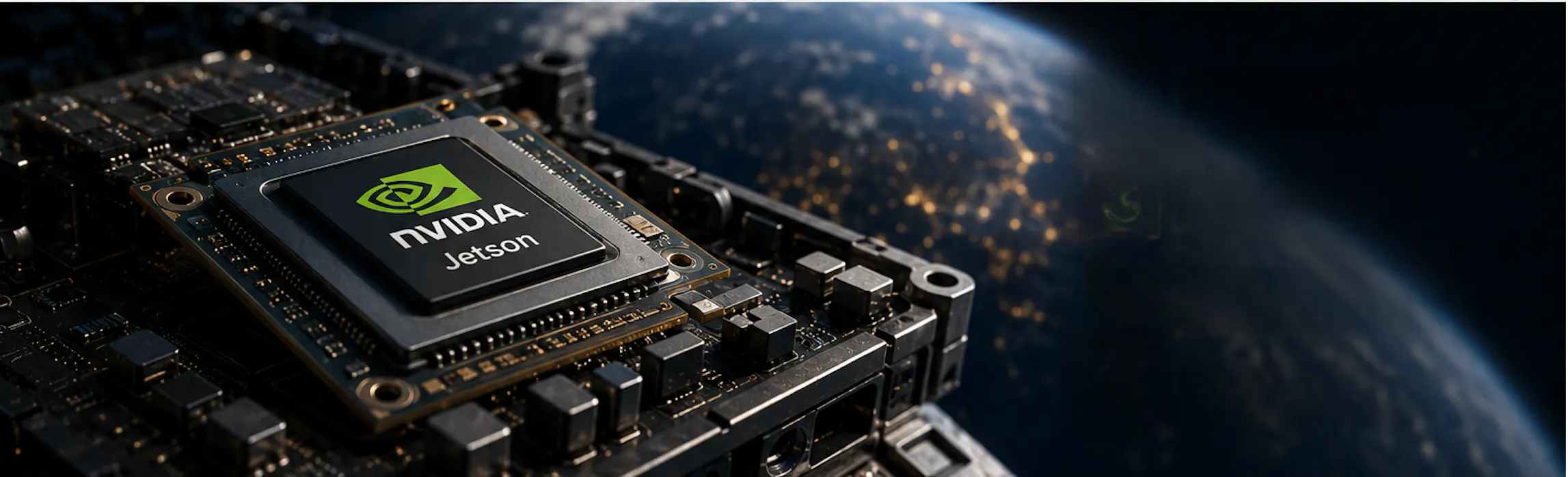
As a result of this marked growth, NVIDIA’s technologies are being integrated into other emerging technologies, for example edge computers, robots, autonomous systems, and for purposes of this article, space applications. The company has over the years positioned itself as more than just a semiconductor manufacturer, cementing its reputation for providing components and infrastructure for data intensive industries. In 2024, the company further expanded its horizons through partnerships across aerospace and autonomous systems sectors, particularly through edge AI platforms such as Jetson, which are designed for power-constrained environments which need onboard machine learning capabilities.These systems have become relevant for satellites and drones which operate where connectivity is intermittent but necessary.
The application of AI in orbit is already visible in climate and disaster monitoring systems. In 2025, several EO programmes began opting into machine-learning systems for wildfire detection signatures and other environmental anomalies derived directly from satellite imagery streams. Rather than waiting for a human operator to review, the GPUs themselves are able to flag priority events independently, substantially reducing response times for emergency agencies.

The commercial value is commensurate with the environment, as faster processing allows satellite operators to provide near-real-time analytics products rather than simply selling imagery. And yes it is common cause that this data must still be extracted and interpreted for it to be valuable, and that is where the computational capabilities introduced by NVIDIA’s products make their most valuable contribution within digital and tech markets.
For the above reasons, advanced semiconductor manufacturing remains highly concentrated geographically, particularly in Taiwan through the Taiwan Semiconductor Manufacturing Company. This concentration creates strategic vulnerabilities across the industries which depend on AI compute infrastructure. With regards to space systems, the issue is even more sensitive since orbital infrastructure carries with it dual-use requirements, and is considered critical for communications and other sensitive resilience networks. In fact, recent US export controls have targeted advanced semiconductor technologies specifically, which shows just how strategic AI hardware is in the realm of trade competition. China on the other hand has accelerated efforts to improve its sovereignty over AI chips manufacturing, which forms part of its broader AI strategy and vision for the industries such as space which are offshoot from its development.
These case studies demonstrate the manner in which satellites are developing into systems that must be capable of interconnecting with other computational networks. This is most apparent in the case of megaconstellations, where satellites share workloads, coordinate observations and collectively distribute processing tasks in a dynamic environment. This is akin to the evolution of terrestrial cloud computing, and as such, companies are now exploring whether future constellations could collectively function also as orbital data-processing infrastructure. This would prove useful for latency-sensitive applications.
Despite the promise of structural and economic resilience, the enthusiasm surrounding orbital AI is constrained. Space-qualified processors must survive radiation and thermal exposures, in addition to the limitations on the availability of power. Even the most advanced of AI chips designed for terrestrial data centres often cannot operate reliable when exposed to the harsh realities of space operations, unless they are modified extensively.Nevertheless, the growing relationship between A chips and space reveals how impactful NVIDIA’s semiconductors are and will be in creating an intelligent, connected and resilient space ecosystem.