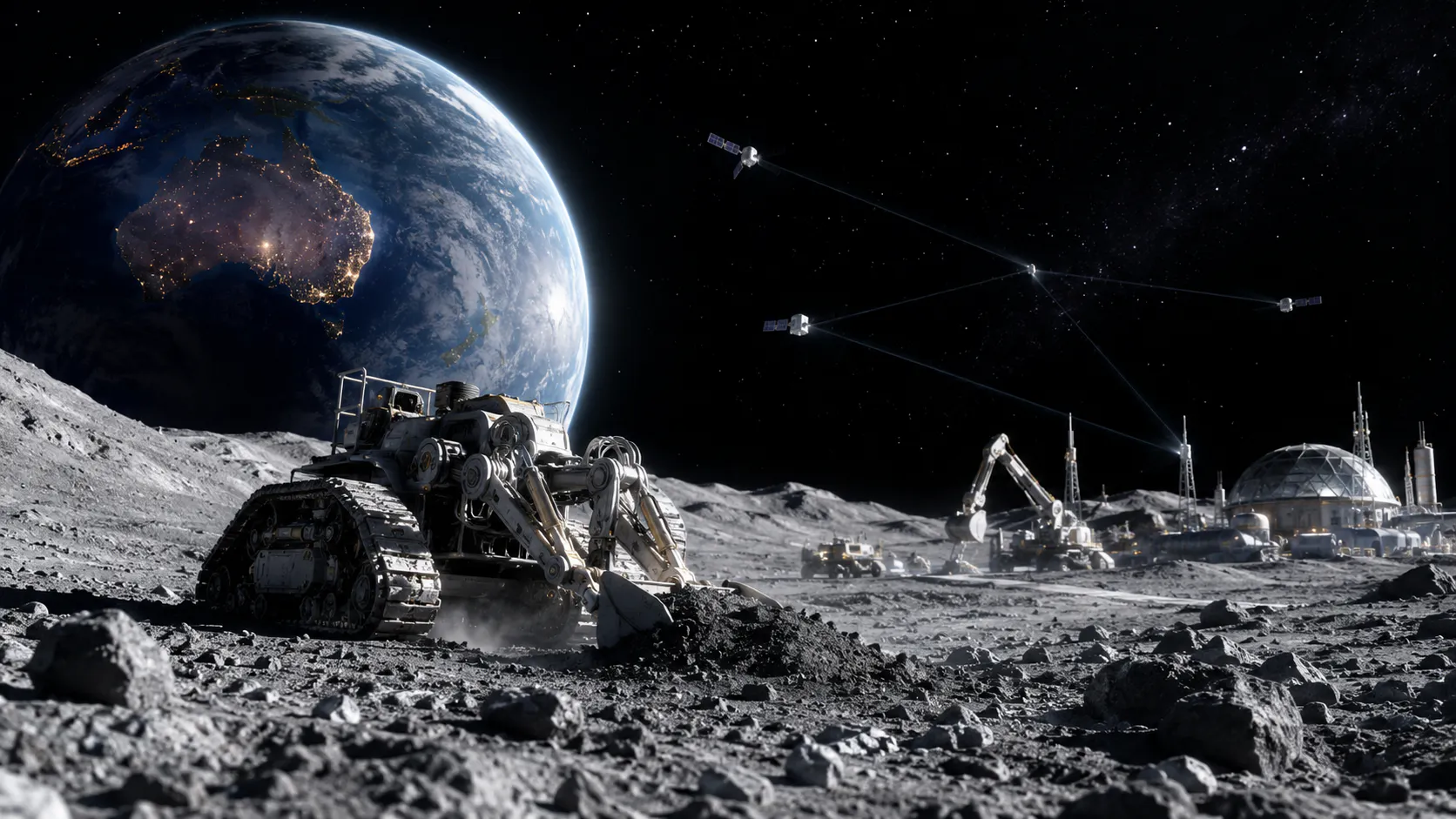
The emerging lunar economy is often discussed through the lens of major space powers returning to the Moon. Yet the future of lunar activity will not be determined only by those who land astronauts or operate launch systems. As lunar missions become more complex, opportunities will increasingly emerge for states that can provide specialised technologies, scientific expertise and commercial capabilities. Australia represents an important example of this shift: a country positioning itself not as a primary lunar destination actor, but as a contributor to the supply chain that may sustain future lunar operations.
Australia’s approach reflects a broader change in space activity. The question is gradually moving from who can reach the Moon? to who can provide the capabilities required to operate there? This distinction matters because long-term lunar activity will require far more than transportation. It will depend on robotics, communications, navigation, resource utilisation, data systems and autonomous operations. Australia’s participation in the Artemis programme provides the foundation for this strategy. In 2020, Australia became one of the original signatories of the Artemis Accords, committing to principles supporting peaceful exploration, transparency and interoperability in lunar activities. However, Australia’s contribution is primarily shaped by its domestic strengths: mining expertise, remote operations, robotics and resource management.
These capabilities are particularly relevant because the Moon presents challenges familiar to Australia’s terrestrial industries. Operating in extreme environments, managing autonomous systems over vast distances and extracting value from limited resources are all areas where Australian companies and research institutions already possess experience.This relationship between terrestrial expertise and lunar opportunity became evident through Australia’s involvement in NASA’s lunar exploration agenda. In 2020, the Australian Space Agency announced the Moon to Mars Initiative, committing funding to develop technologies that support Australia’s role in future exploration missions. A central focus has been developing robotic systems capable of supporting lunar operations.
One of the most prominent examples is the Australian-built lunar rover concept developed through the Australian Space Agency’s partnership with industry. The rover, selected as part of Australia’s contribution to NASA’s Artemis programme, is designed to collect lunar regolith and support future resource utilisation activities.
Although the mission has evolved through development stages, its significance lies in the industrial capability it seeks to establish: Australian companies participating in the emerging lunar value chain.
This illustrates an important economic principle. Space economies are not created solely through ownership of missions; they develop through participation in the surrounding ecosystem. For Australia, the opportunity is not necessarily competing with the United States or China in lunar exploration, but becoming a specialised contributor in areas where it has comparative advantages.
One such area is lunar resource utilisation. The Moon’s south pole has attracted significant attention because of possible water ice deposits, which could eventually support the production of oxygen, water and propellant. While commercial extraction remains technologically and legally challenging, the prospect of using lunar resources has changed how governments view the Moon: not only as a scientific destination, but as a potential operational environment.
Australia’s mining sector has naturally attracted attention in this context. Technologies developed for autonomous mining, remote sensing and harsh environments may have relevance for future lunar activities. However, transferring terrestrial expertise to the lunar environment is not straightforward. The Moon lacks atmosphere, experiences extreme temperature variations and requires systems capable of operating with minimal human intervention. The commercial question therefore becomes one of adaptation. Can existing Australian capabilities be transformed into space-qualified technologies?
This is where the role of partnerships becomes important. Australia’s lunar ambitions depend heavily on collaboration between government, universities and industry. The Australian Space Agency has emphasised the importance of developing domestic capability while integrating into international missions. This reflects a broader model emerging among middle space powers: leveraging partnerships to access major programmes while developing niche expertise.
Nevertheless, several challenges remain. The first is commercial certainty. Lunar markets are still developing, and many business cases depend on government-led missions creating initial demand. The second is regulatory coordination. Activities involving lunar resources, data sharing and commercial operations require clearer international frameworks. The Outer Space Treaty establishes principles of peaceful use and non-appropriation, but practical questions surrounding resource utilisation remain under active discussion.
The third challenge concerns continuity. Space capability requires long-term investment cycles, often extending beyond political terms. Australia’s ability to benefit from lunar opportunities will depend on maintaining consistent support for research, industry development and international cooperation.
The broader lesson from Australia’s approach is that the future lunar economy will likely resemble other complex industries: distributed, specialised and dependent on networks of suppliers. Just as global industries rely on interconnected manufacturing and logistics systems, lunar operations will require contributions from multiple countries with different strengths.
Australia’s emerging lunar strategy demonstrates how space participation is evolving beyond traditional measures of capability. The next phase of exploration will not only reward those who reach new destinations, but those able to provide the systems, services and technologies required to operate there.
Through robotics, autonomous systems, mining expertise and international partnerships, Australia is positioning itself within the developing lunar supply chain. The challenge now is converting technical capability into sustained commercial value. As lunar activity expands, influence may increasingly belong not only to those who explore the Moon, but to those who help make it operational.