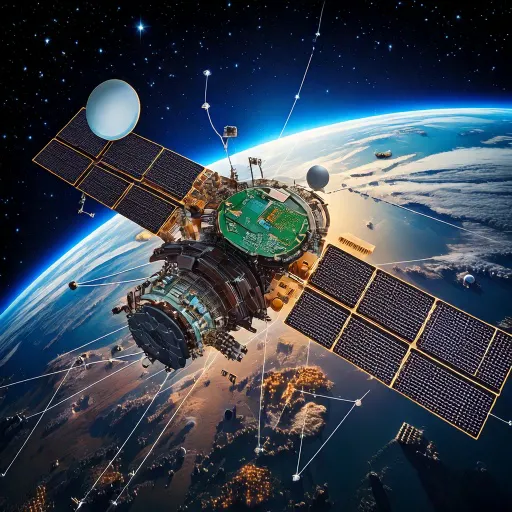
It is common cause that satellites provide a bird’s-eye view of our life here on Earth, relaying vital data that helps us make decisions concerning our everyday lives. They have collected information, sent signals, and relied heavily on Earth-based systems to process this data into actional information. What then of this growing phenomenon where spacecraft are beginning to think for themselves? This transformation is being driven not only by advances in artificial intelligence, but also by semiconductor infrastructure which makes such intelligence possible. The modern space economy is quietly becoming dependent on this new strategic resource, contained in small but highly advanced AI chips.
This shift is important as engineering becomes more sophisticated, requiring access to high-performance semiconductors. In their own right, they represent an emerging geopolitical issue, as countries contest not only for access to space, but also access to this vital piece of enabling technology. Indeed the geopolitics of computational power is as important a consideration as the space technology itself.
Traditionally, satellites have operated through constant communication with ground stations. Commands are sent from Earth, processed onboard, and executed relatively slowly. This model has worked in earlier eras where the orbital traffic was limited and missions were comparatively simpler than they are now. But the space environment continues to evolve rapidly, and especially in the era of mega-constellations, cislunar missions and deep-space exploration, the additional challenges that come with moving further from Earth, such as communication delays, make constant human intervention all but impractical.
As a result, spacecraft need to be able to handle onboard operations autonomously in order to manage collision avoidance, power systems, process imagery and also coordinate with other spacecraft in near real-time. This demands a level of computational capability that older space systems were never designed to support. The challenge, though, is that space is an exceptionally hostile environment for the entire space system, but especially for electronics. Radiation exposure places enormous constraints on onboard computing systems, and conventional consumer processors often cannot survive prolonged exposure beyond Earth’s atmosphere. This has accelerated investment into specialised radiation-hardened semiconductors, capable of supporting AI-enabled operations in orbit.
Such enhanced capacity is necessary where data volumes derived from satellites are expanding faster than communications systems can comfortably handle. Earth observation satellites alone generate terabytes of imagery daily. Processing information onboard reduces bandwidth requirements while enabling faster decision-making. This becomes particularly important in military and strategic applications where speed determines advantage.
The geopolitical significance of semiconductors is hardly new however. Recent years have seen intensifying competition between the United States and China over advanced chip manufacturing, particularly with regards to exports controls and supply chain security. What is changing however is the degree to which this semiconductor rivalry is extending into space. So while the geopolitics of AI chips is not a new phenomenon, the orbital environment introduces entirely new operational stakes. For instance, a satellite constellation capable of autonomous coordination possesses strategic advantages in communication resilience. Similarly, lunar missions operating at large distances from Earth will likewise require onboard AI systems capable of independent decision-making due to communication latency.
In addition to themes already discussed, such as launch cadence as determinants of future space power, the growing list may further include computational sovereignty. That is to say, the countries capable of designing and manufacturing advanced AI-enabled space hardware could gain disproportionate influence over the future space economy. China has moved aggressively in this regard, reducing its dependence on foreign semiconductor technologies while simultaneously expanding its space capabilities. The country’s broader industrial strategy treats AI, quantum technologies and aerospace infrastructure as interconnected pillars of national development.
Meanwhile the United States continues to dominate many aspects of advanced semiconductor design through companies such as NVIDIA whose graphics processing units (GPUs) have become foundational to AI training and high-performance computing globally. Although most headlines surrounding NVIDIA focus on terrestrial AI markets, the underlying technologies are also growing in relevance for autonomous spacecraft operations and especially for robotic exploration systems, as well as data processing.

The issue then goes beyond commercial dominance. Semiconductor supply chains remain geographically concentrated and politically sensitive. Taiwan continues to occupy a central role in global advanced chip manufacturing through the Taiwan Semiconductor Manufacturing Company, which unfortunately creates strategic vulnerabilities that extend directly into future space operations. In practical terms, space autonomy is intrinsically linked to the fabrication ecosystems we have on Earth.
Across the aerospace sector, space systems are replacing passive hardware in favour of intelligent networked systems capable of adapting to the dynamic shifts in space and in the space industry itself. This transition resembles earlier moments in technological history where infrastructure changed character entirely. Railways once transformed industrial economies by connecting territory physically. And now digital networks are connecting economies informationally. AI-enabled orbital systems may in future serve to connect infrastructure computationally as well. As these systems mature, computational capability becomes inseparable from space capability itself.
This also raises governance concerns, as autonomous systems operating in orbit introduce questions surrounding accountability. A malfunctioning AI-enabled satellite could potentially affect multiple operators in congested orbital regions, for example.
The need for international coordination will be heightened as the next phase of the space economy takes shape. One might even posit to say that launch cadence may soon be as vital as semiconductors or even the rocket systems themselves. AI chips are deemed foundational pieces of equipment for autonomous satellites, therefore, the more crowded the orbital ecosystem becomes, the further the geopolitical contest surrounding semiconductors is likely to grow. This competition is gradually extending upward into orbit, where the future architecture of space is becoming somewhat resilient but most certainly intelligent.