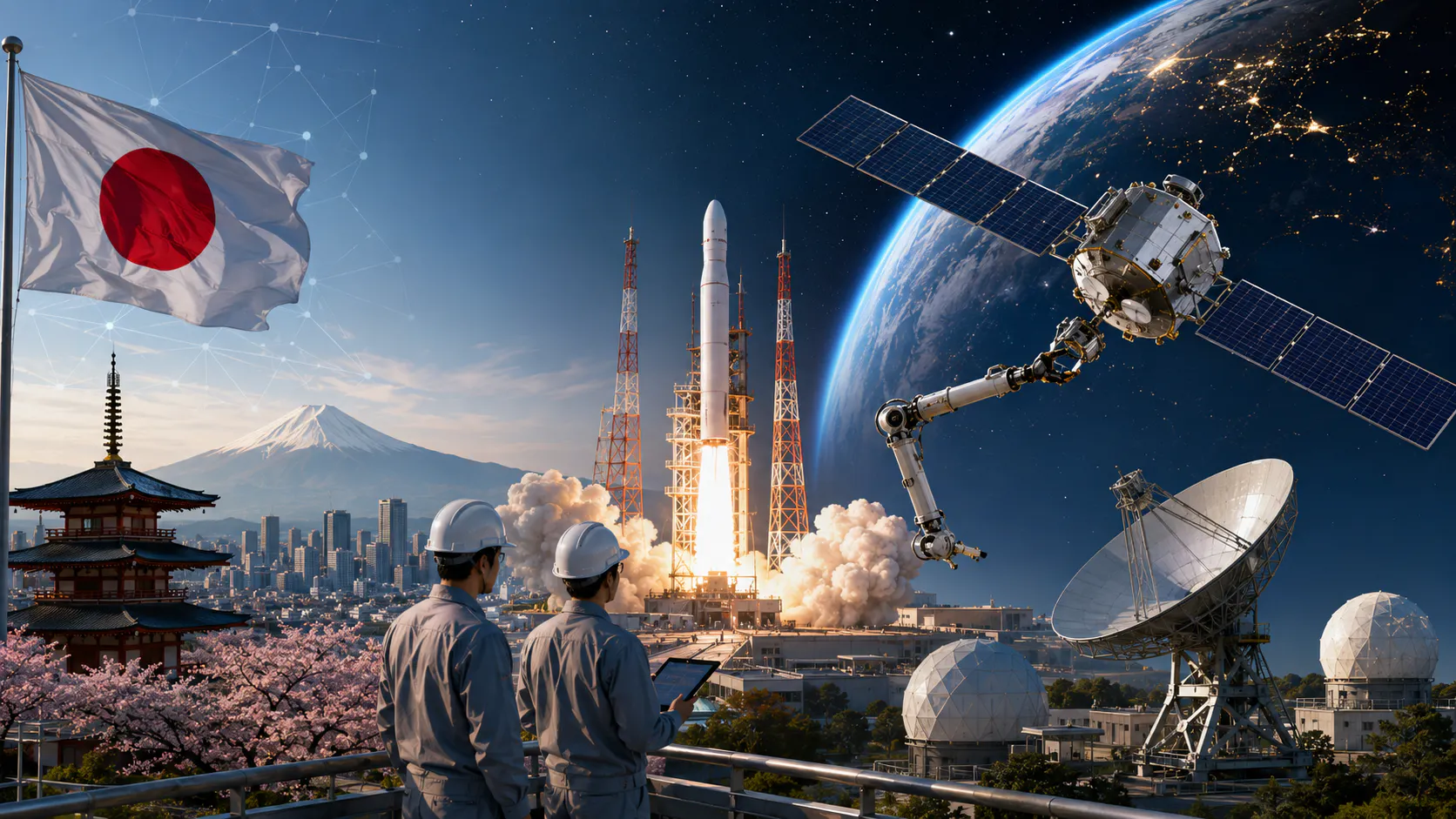
Japan occupies a distinctive position in the global space economy: technologically advanced, operationally reliable, yet still in the early stages of building a fully commercial space ecosystem. The challenge it faces is not capability development in the narrow sense (few states match its engineering precision) but rather the transformation of state-led space excellence into scalable, privately driven markets. This transition is proving to be structurally complex, requiring regulatory reform, demand creation and sustained institutional coordination.
At the centre of Japan’s space architecture is the Japan Aerospace Exploration Agency (JAXA), which has historically anchored national missions in science, exploration and Earth observation. Established through the consolidation of earlier institutions in 2003, JAXA has delivered a consistent record of high-precision missions, including asteroid sample return programmes and deep space exploration.However, its mandate has traditionally been aligned with public-sector objectives rather than commercial market development. This distinction is critical as excellence in mission delivery does not automatically translate into a vibrant private sector.
For much of Japan’s space history, industry participation was largely structured around subcontracting relationships with government programmes. Firms supplied components, engineering services and manufacturing support, but rarely operated as independent market actors with their own launch customers or revenue streams. This model produced high technical reliability but limited entrepreneurial dynamism.
Recognising this constraint, Japan began to shift its regulatory framework during the 2010s. A key milestone was the enactment of the Space Activities Act (2016), which introduced a licensing regime for private space operations, including launch services and satellite deployment. This legislation marked a structural departure from purely state-driven space activity, signalling that commercial operators could now assume direct responsibility for missions under government oversight.
The intention was not deregulation, but structured market formation. By defining liability, insurance requirements and approval pathways, the Act created conditions for private investment while maintaining strong state supervision. In principle, this aligned Japan with broader global trends in space commercialisation. In practice, however, regulatory change alone has not been sufficient to generate a self-sustaining launch market.
A case that illustrates both ambition and constraint is Space One, a privately funded launch company aiming to establish Japan’s first commercial small satellite launch service.Its flagship vehicle, Kairos, represents an attempt to enter the rapidly growing small satellite launch segment, where responsiveness and cost efficiency are key competitive factors.
However, Kairos has faced repeated technical setbacks, including failed launch attempts that highlight the difficulty of developing reliable orbital launch capability outside established state programmes. While such failures are not unusual in early-stage launch development, they underscore the broad structural reality of launch markets being extremely capital-intensive, technically unforgiving and slow to mature.
Japan’s experience therefore illustrates a critical distinction in space commercialisation. Regulatory openness does not automatically generate industrial capacity. Instead, it must be paired with sustained demand, coupled with de-risking and long-term capital investment. These are fundamental elements that are still emerging within Japan’s private launch sector.
In the converse, and where Japan has seen comparatively stronger commercial traction is in downstream and adjacent markets, particularly in robotics, satellite services and orbital sustainability. A notable example is Astroscale, a private company founded in Japan that focuses on space debris removal and in-orbit servicing. Astroscale’s model reflects an important shift in the economics of space, where companies are beginning to monetise the maintenance, repair and decommissioning of orbital assets.
This methodology frames sustainability challenges as commercial opportunities. As satellite constellations expand and orbital congestion intensifies, demand for debris mitigation, life extension services and orbital logistics is expected to grow.Japan’s positioning in this segment aligns well with its strengths in precision robotics and systems engineering.
At a regional level, Japan’s commercial challenges must also be understood in relation to broader Asia-Pacific dynamics. India’s expanding private space sector, China’s state-led industrial model and Australia’s service-oriented approach all represent alternative pathways to space commercialisation. In comparison, Japan’s model is characterised by high technological maturity but relatively cautious market expansion. This caution is partly institutional. Space development in Japan has historically been closely tied to national priorities, including scientific research, technological demonstration and industrial policy. Transitioning from this framework to one that tolerates higher levels of commercial risk requires not only legal reform but also cultural and financial adaptation within industry and government.
Unlike mature aerospace markets such as the United States, where venture capital and defence procurement provide strong demand signals, Japan’s private space firms often rely on a combination of government contracts and long development cycles. This can slow commercial scaling, even when technical capability is strong, necessitating strong investment structures to mitigate.
Nevertheless, Japan’s long-term trajectory remains significant and promising. Its strengths in robotics, miniaturisation, materials science and reliability engineering position it well for emerging space markets beyond launch, including in-orbit servicing, autonomous systems and lunar support systems, which sectors may ultimately prove more commercially viable than competing directly in launch services.
Japan’s case study reveals the opportunity to grow in space ecosystem design. While the country possesses world-class engineering capacity and a highly capable space agency, the transition to a fully commercial space sector requires sustained market formation, in addition to the already present market readiness element.
The emergence of companies such as Space One and Astroscale reflects early-stage progress, but also highlights the structural difficulty of building competitive launch and orbital service markets. Japan’s future role in the global space economy may therefore lie in high-reliability, technology-intensive niches where its industrial strengths can be most effectively leveraged. In this sense, Japan is not late to the commercial space economy. It is instead navigating one of its most difficult transitions, namely, converting institutional excellence into scalable markets.