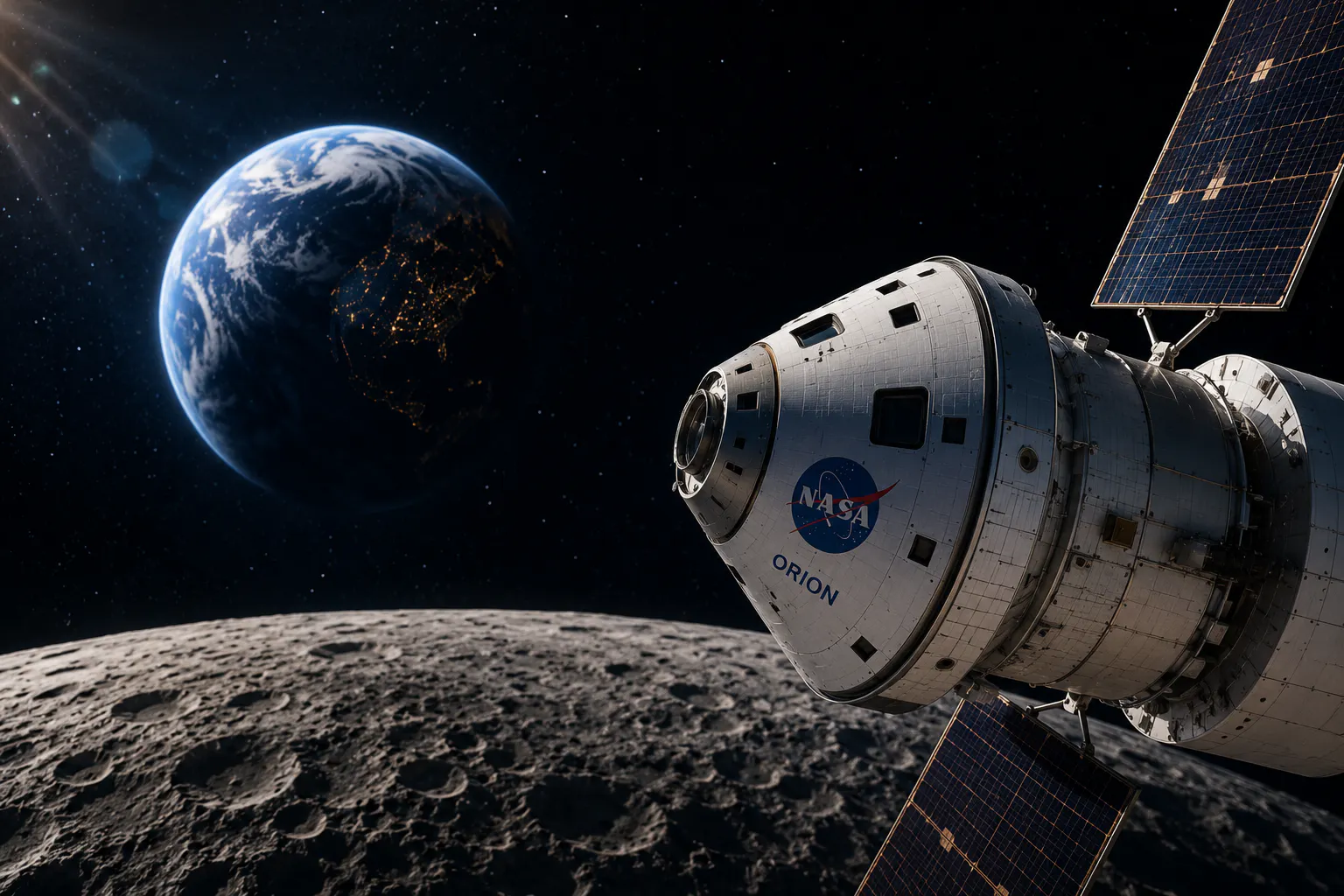
Space missions are not always made significant by where they go. Oftentimes, they are measured by what they are above to prove. In April of 202, four astronauts represented humanity during the first mission to complete a lunar flyby mission since Apollo 17, and served to validate the efficiency of the Orion spacecraft as well as the Space Launch System (SLS) developed by NASA.Through these two vehicles, the Artemis II mission achieved something that had not occurred since December 1972, i.e. a crewed spacecraft travelling beyond Low Earth Orbit (LEO), operating in deep space, circumnavigating the Moon and finally returning home safely.
While many headlines are rightfully centered on the symbolic return of humans into lunar space, the mission's value lay in the large-scale validation exercise for the systems that will underpin the next generation of human exploration. So while the Apollo programme demonstrated that reaching the Moon was possible, it is the Artemis mission that will attempt to determine whether life and operations beyond Earth orbit are viable and sustainable.
Testing the Architecture
The Artemis 2 mission was NASA’s first crewed flight using the Orion spacecraft and SLS, following the earlier uncrewed Artemis 1 mission in 2022. The four astronauts spent approx. ten days in space, subsequently completing the full lunar flyby before returning to Earth via controlled splashdown.Distance presents the most extenuating factor to achieving full autonomy beyond Earth’s orbit. The International Space Station orbits roughly 400 kilometres above Earth for example. During the Artemis 2 mission, Orion travelled a total distance of 252,756 miles which is approximately 406,771 kilometres from Earth.
The scale of this achievement is evident in how incredibly far the crew traveled - farther from Earth than any humans in history - and in the extensive research and system testing conducted in deep space, far beyond the range of rapid physical support. This feat further solidified NASA’s technical capabilities and its readiness for sustained lunar exploration. In practical terms, crews should be able to operate with greater autonomy, and for this, the systems they use need to demonstrate a high-level of reliability. The successful completion of the mission therefore reduced a wide range of technical and operational uncertainties that have existed since the Artemis programme began.
What We Learned
Perhaps the most important outcome was the confirmation that Orion’s life support and habitation systems can support human crews beyond LEO for extended period of time. It’s safe to say that human missions impose greater standards than robotic ones, and for this reason, contingency planning becomes a fundamental theme for maintaining crew safety over long durations. The mission also generated valuable data on the way in which the human body performs in deep space. Space unfortunately carries the risk of exposure to radiation, confinement, and communication delays, all whilst balancing operational requirements far removed from normal enabling infrastructure.This is again exacerbated by the psychological impact that astronauts may face being far removed from their usual comforts. Artemis 2 provided an opportunity to study these challenges under real mission conditions rather than through simulations alone.
Equally important was the need to validate navigation and communication systems, which will depend on complex networks involving spacecraft, surface assets, orbital infrastructure as well as interoperability amongst international partners. As coordination and international cooperation are considered paramount and foundational principles as expressed in the treaty frameworks, then at the very least such missions should show their capability to perform across vast and tenuous distances for the sake of the scientific research and safety of the astronauts, as well as the corresponding interests of all humankind to have space be used for peaceful and sustainable purposes.
What Remains Unresolved
In this context, the word success should not be used interchangeably with completion. Although the Artemis 2 put to bed some of the more significant challenges witnessed during previous missions, there are still some which exist before long-term lunar operations become feasible. The Artemis 3 mission, which is currently planned as the first mission to return astronauts to the lunar surface, depends upon technologies and partnerships that remain under development. Among the most prominent is the Human Landing System being developed by SpaceX. Its architecture will require orbital refueling operations that have never been conducted at the scale envisioned for lunar missions. It must be remembered that to sustain operations long-term requires a continuous supply of resources for both humans and machines. The Lunar Gateway station, intended to support future cislunar operations, remains under construction for this reason.
These dependencies help us understand important characteristics of modern space programs. Unlike Apollo, which was largely vertically integrated under a single national effort, the Artemis 2 case study relies upon a distributed, multipolar ecosystem including governments, agencies and especially commercial providers. And the success of this collaboration is as dependent on coordination as it is on engineering.
As alluded to at the beginning of this article, it's common to evaluate space missions based on the visible milestones, whether they be launched or otherwise. But space program managers would beg to differ, frequently assessing success through a different lens. In complex systems, eliminating uncertainty can be just as valuable as achieving new destinations. From this perspective, Artemis 2 achieved its primary purpose. This mission generated data, validated hardware and provided evidence that the programme’s broader architecture can not only support human activity, but will still continue to inspire humanity to shoot for the stars. So while these outcomes may appear less dramatic than a lunar landing, they are, in the face of the space science community, arguably more important for long-term mission planning.