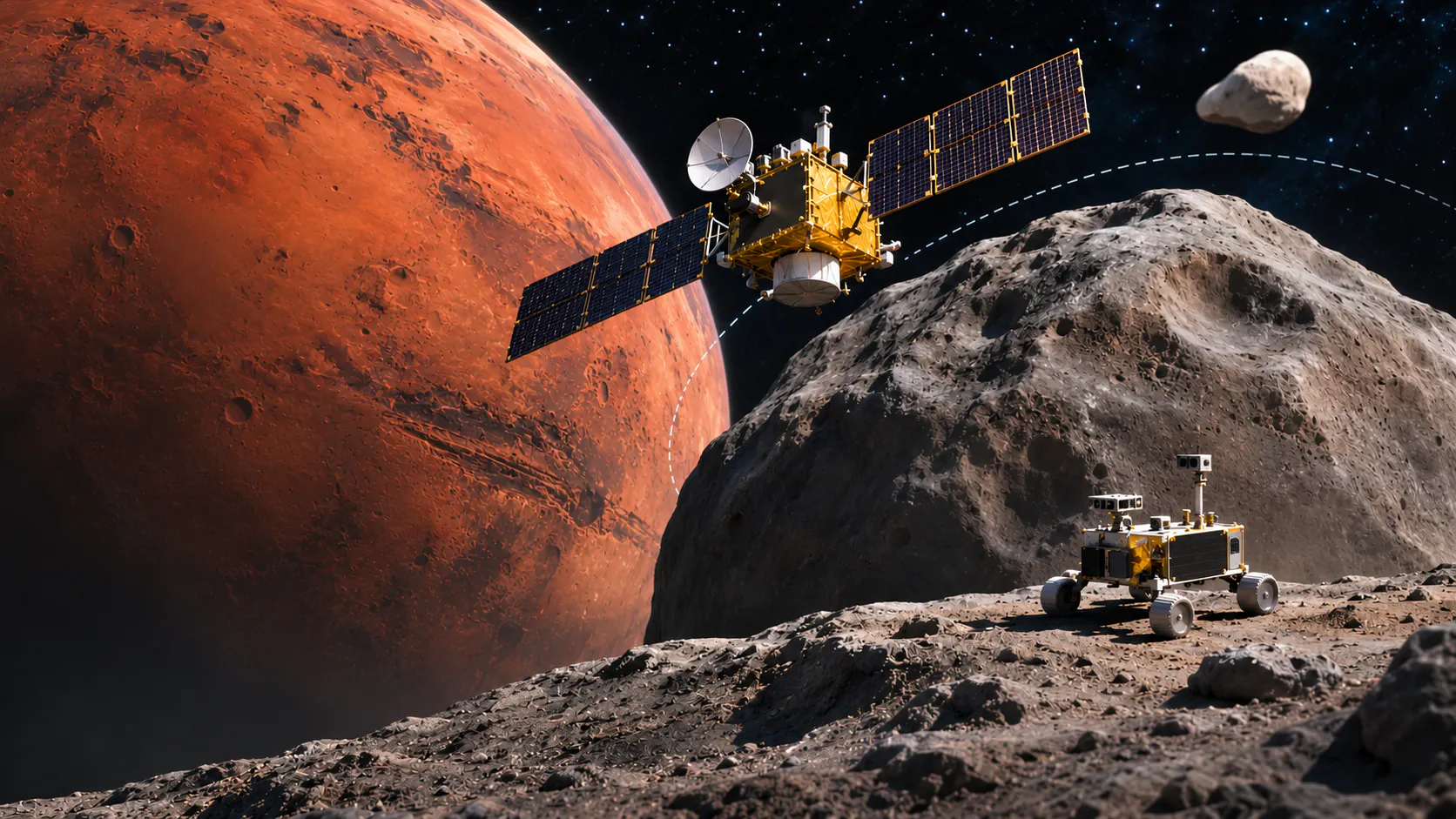
A sample weighing at least 10 grams could help scientists resolve one of planetary science’s persistent questions: how did Mars acquire its two small moons? Japan’s Martian Moons eXploration (MMX) mission launched on 19 October 2026 aboard an H3 rocket, beginning a five-year journey that is intended to return material from Phobos to Earth in 2031.The mass of the planned sample is modest. The infrastructure required to retrieve it from another planetary system is not. Led by the Japan Aerospace Exploration Agency (JAXA), MMX will study both Phobos and Deimos, deploy a French-German rover onto Phobos and attempt a surface landing to collect samples. Its findings could help distinguish between competing explanations for the moons’ origins, firstly, that they are asteroids captured by Mars’s gravity, or secondly that they formed from material ejected during an ancient impact on Mars.MMX is expected to reach Mars in August 2027, with operations around Phobos following later that year. The mission is designed to survey the moons, characterise their surfaces and internal properties, and collect at least 10 grams of material from Phobos before returning the sample capsule to Earth in 2031.
That sequence involves several distinct engineering challenges. The spacecraft must navigate into the Martian system, operate in the gravitational environment around Phobos, approach and contact the surface, collect material, then depart for Earth with the sample securely stored. Each stage constrains the next. A successful launch establishes that the spacecraft has begun its journey; it does not establish that the sampling and return operations will succeed. The rover adds another layer, as Idefix, developed jointly by France’s CNES and Germany’s DLR, is expected to reach Phobos around the turn of 2028–29 and operate for approximately 100 days. Its job includes examining the surface and helping characterise the environment in which the main spacecraft will operate.Because Phobos has extremely weak gravity, mobility and contact with the ground behave differently from equivalent operations on Earth or the Moon. The rover’s design must accommodate that environment, while its observations contribute to the wider mission. This is where the mission’s technical architecture becomes commercially and strategically relevant. Deep-space capability is not one technology that can be purchased and installed. It is a combination of propulsion, navigation, communications, robotics, autonomous operations, sampling systems and mission control. MMX brings these elements together in a programme that tests Japan’s ability to manage a complex round trip beyond Earth orbit.
MMX is led by JAXA, with contributions from NASA, ESA, CNES and DLR. Their roles are specific rather than merely diplomatic. NASA is supplying the MEGANE gamma-ray and neutron spectrometer, which will help determine the elemental composition of Phobos’s surface. ESA has contributed deep-space communications equipment and ground-station support, while France and Germany jointly developed the Idefix rover. The division of work matters because a mission of this complexity draws on capabilities distributed across different national space programmes. Japan supplies the mission leadership and spacecraft architecture; partners contribute specialised instruments, robotics, communications infrastructure and scientific expertise. The result is a shared mission whose performance depends on each contribution functioning within a common technical system. This arrangement also distributes the value of the mission. Partners gain opportunities to test instruments, develop operational expertise and participate in the analysis of data and returned samples. ESA has confirmed that European scientists will participate in planning observations, analysing instrument data and studying the material returned from Phobos. The benefits therefore extend beyond the spacecraft itself to scientific institutions and future mission design.
Cooperation, however, introduces coordination requirements. Hardware must be delivered and integrated on time, interfaces must remain compatible, and scientific observations must be planned across instruments and mission phases. International participation expands the capability available to a programme, while making effective coordination essential to its execution. MMX is also the first interplanetary mission launched by Japan’s H3 rocket. That gives the launch vehicle a role beyond delivering a payload to orbit: it has now supported the departure of a spacecraft on a trajectory towards Mars. The distinction is important for Japan’s wider space ambitions. A national launch system provides a route to orbit, but deep-space missions require a larger set of capabilities after separation from the rocket. MMX connects launch infrastructure to spacecraft development, planetary navigation, scientific instrumentation and sample-return operations. It offers a concrete example of how those capabilities can be combined in a demanding mission. The achievement should not be confused with proof that every element of Japan’s deep-space architecture is mature or commercially scalable. MMX is a specialised scientific mission, and its costs, technical requirements and operational schedule differ from those of routine commercial launches. Its contribution is evidence of capability demonstrated at the launch stage, followed by a long sequence of operations still to come.
That distinction is useful when assessing national space programmes. Launch milestones attract attention because they are visible and immediate. The value of a mission such as MMX will be determined over years, through the quality of its observations, the success of its sampling operation and the return of material that scientists can study directly. If MMX succeeds, researchers will gain access to samples from Phobos for laboratory analysis, alongside observations of both Martian moons. The material may help clarify whether the moons formed from debris generated by an impact on Mars or were captured from the asteroid population. It could also contain evidence of processes that shaped the early Martian system. The mission’s wider significance lies in the capabilities required to bring that evidence home. Japan has launched the spacecraft, but the central scientific result remains years away. Until the sample is collected and returned, the mission’s most consequential promise is still a target. MMX is therefore best understood as a long-duration test of an integrated space programme: launch, deep-space operations, international technical cooperation, surface sampling and return. The 10 grams matter because they represent the end product of that entire chain. In planetary exploration, the achievement is not simply to reach a distant world. It is to return with something that can change what we know about it.