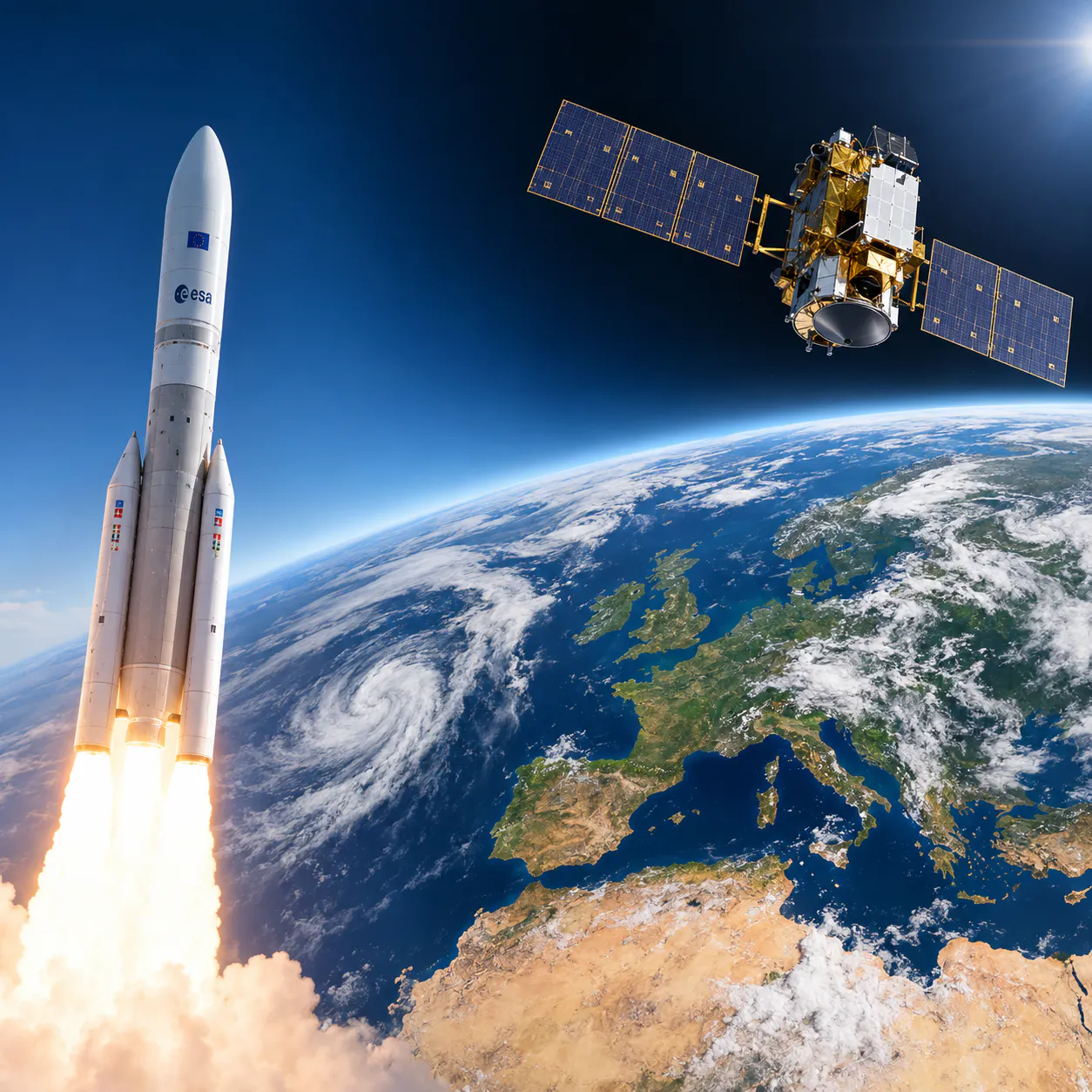
Every two and a half minutes, Europe’s newest weather satellite can produce a new view of rapidly changing conditions across Europe and North Africa. MTG-I2, the latest Meteosat Third Generation imager, carries instruments designed to detect severe storms, monitor lightning and improve short-term weather forecasting from geostationary orbit. On 27 August, that capability began its journey there aboard Ariane 6. The mission was significant for both payload and launcher. Ariane 6’s two-booster Ariane 62 configuration placed MTG-I2 into geostationary transfer orbit, marking the rocket’s first flight to that destination and its ninth flight overall since entering service in 2024. MTG-I2 subsequently completed its transfer to geostationary orbit, approximately 36,000 kilometres above Earth, where it will form part of Europe’s operational meteorological infrastructure.MTG-I2 is part of a programme developed by the European Space Agency around requirements collected by EUMETSAT, while the satellite itself was built by a European industrial consortium led by Thales Alenia Space, with OHB System and Leonardo among its principal partners. EUMETSAT operates the satellites, manages the associated ground infrastructure and distributes the resulting meteorological data.The launcher therefore sits within a wider European chain connecting public requirements, industrial production, launch services, orbital infrastructure and public data.
Ariane 6 has also begun to move beyond institutional missions. In 2026, Arianespace used the launcher to deploy Amazon Leo satellites on three missions, placing 100 spacecraft into orbit in less than five months.In September, Amazon Leo ordered six additional Ariane 64 launches, taking the total number of Ariane 6 missions contracted for the constellation to 24 through 2031. The additional flights are scheduled to begin in 2029. Such an order changes the industrial calculation around Ariane 6. A launcher designed partly around Europe’s requirement for institutional access now has a substantial commercial manifest extending across several years. The Amazon missions provide predictable demand against which production, launch-site operations and supplier capacity can be organised, while the institutional programme continues to depend upon the same underlying launch infrastructure. The question for Europe is therefore becoming one of cadence, a growing industry metric underpinning access to space. Arianespace has stated an objective of reaching a stable rate of nine to ten Ariane 6 launches a year from 2027. ArianeGroup has also been examining whether production could eventually increase beyond that level, although the company has identified supply-chain constraints, including the availability of solid propellant, as an obstacle to further expansion. Around 600 companies form part of the wider supply chain. The numbers matter because access to orbit is only useful as an industrial capability when it can be delivered at the frequency required by the missions waiting for it. A single successful launch demonstrates technical capability. A repeatable launch schedule requires manufacturing capacity, qualified suppliers, launch infrastructure, financing, customers and enough institutional and commercial demand to sustain the system.
Ariane 6 is now accumulating some of those conditions, with the MTG-I2 mission demonstrating its ability to serve a demanding geostationary institutional payload. Amazon Leo provides a recurring commercial customer. Additional agreements announced in September with European and international satellite operators have expanded the prospective customer base. The programme is consequently moving from the question of whether Ariane 6 can reach orbit towards the more industrial question of how many missions Europe can reliably execute each year. That distinction also matters for the governance of European space activity. ESA oversees the development programme, Arianespace provides launch services, national industries manufacture components and spacecraft, EUMETSAT operates meteorological infrastructure, and commercial customers bring their own constellations and business requirements. The launcher is therefore not an isolated European asset. It is one component within a network of public institutions, private companies and international programmes whose activities depend upon reliable access to space.
Ariane 6’s first journey to geostationary transfer orbit does not settle Europe’s launch position. It establishes another piece of the infrastructure on which that position will depend. Turning that capability into a dependable rhythm of access will be the longer project.